

Posts

Bean Counter’s Bible: Choosing the Right Workers’ Comp Policy for Restaurants and Construction

For both restaurant owners and construction companies, selecting the right workers’ compensation policy is crucial for managing cash flow and risk. The best choice often depends on your business’s specific payroll fluctuations.

Payment Methods: A Comparison

1. Monthly Payroll Reports (MPR) 📊

This method is perfect for businesses with fluctuating payrolls, especially those in the restaurant and hospitality industry.

  • How it works: You pay an upfront deposit (e.g., two months’ worth of estimated premium) and then submit a report of your actual payroll each month. Your premium is calculated and paid based on these real-time numbers.
  • Pros for Restaurants: Restaurants often hire extra staff for seasonal rushes (summer patios, holiday parties) and special events. The MPR method ensures your premium payments adjust with your payroll, so you only pay for the coverage you need, when you need it. This helps prevent a large, unexpected bill after a busy season.

2. Installment Method with an Annual Audit 🗓️

This method offers predictable, equal monthly payments, which can be attractive for construction companies with a more stable, long-term workforce.

  • How it works: You pay a larger upfront deposit (e.g., three months’ worth) and then make nine equal monthly payments based on an estimated annual premium.
  • Pros for Construction: Construction crews may work on long-term projects with a consistent number of employees. This method allows for easier budgeting because you know your monthly insurance cost upfront. However, this is only a “pro” if your workforce and payroll are stable.
  • Cons for Both: The major drawback is the annual premium audit. If your actual payroll was higher than the estimate, you’ll receive a bill for the difference, which can be a significant surprise. This can be especially risky for construction companies that win a large new project mid-year and hire more workers than originally planned.

Bonus Section: Workers’ Comp Laws by State for Your Industry

Workers’ comp laws are highly state-specific, and the requirements for restaurants and construction can differ.

  • California & Arizona: Workers’ compensation is mandatory for all employers with at least one employee. This is a “no-fault” system. In construction, these laws are strictly enforced, given the high-risk nature of the work.
  • Washington: As a monopolistic state, employers, including those in construction and restaurants, must purchase workers’ comp from the state fund (L&I). This is a crucial distinction from states that allow private insurers.
  • Texas: Texas is unique as the only state where private workers’ comp is voluntary. This means a restaurant or construction company can choose to “non-subscribe” to the state system, but they lose legal protections from employee lawsuits. Given the high-risk environment of construction, this is a dangerous choice.
  • Tennessee: Workers’ comp is generally mandatory for employers with five or more employees, but for construction and coal mining, it’s mandatory if you have just one employee. This highlights the state’s specific risk assessment for the industry.
  • District of Columbia: Workers’ comp is mandatory for nearly all employers. A restaurant or construction company must secure coverage through a private carrier.

Disclaimer: The Dangers of Not Having Workers’ Comp ⚠️

While some states, like Texas, allow you to opt out, the financial and legal risks for both a restaurant and a construction company are enormous.

  • For Restaurants: An employee falling in the kitchen or slipping on a wet floor could result in a serious injury. Without workers’ comp, the restaurant owner is personally and financially liable for all medical bills and lost wages. A single claim could bankrupt the business.
  • For Construction: Given the inherent dangers of the job—falls from heights, heavy machinery accidents, etc.—a serious injury is not a matter of “if,” but “when.” Not having workers’ comp leaves a construction company vulnerable to a ruinous lawsuit that could put them out of business forever.

The only “pro” of not having a policy is avoiding premiums, but for both of these industries, the security and peace of mind provided by workers’ compensation are essential investments.


Have Questions? We’re Here to Help

Navigating workers’ compensation can be complex, and the right choice for your business depends on many factors. We’re here to help you understand your options and make an informed decision. If you have any questions about which policy is best for your business, or about workers’ comp laws in your state, please don’t hesitate to reach out to us. We look forward to working with you.
Eligible Employers can request an advance of the Employee Retention Credit by submitting Form 7200

IRS UPDATE: The Employee Retention Credit is a refundable tax credit against certain employment taxes equal to 50 percent of the qualified wages an eligible employer pays to employees after March 12, 2020, and before January 1, 2021. Eligible employers can get immediate access to the credit by reducing employment tax deposits they are otherwise required to make. Also, if the employer’s employment tax deposits are not sufficient to cover the credit, the employer may get an advance payment from the IRS.

For each employee, wages (including certain health plan costs) up to $10,000 can be counted to determine the amount of the 50% credit. Because this credit can apply to wages already paid after March 12, 2020, many struggling employers can get access to this credit by reducing upcoming deposits or requesting an advance credit onForm 7200, Advance of Employer Credits Due To COVID-19.

Employers, including tax-exempt organizations, are eligible for the credit if they operate a trade or business during calendar year 2020 and experience either:

  1. the full or partial suspension of the operation of their trade or business during any calendar quarter because of governmental orders limiting commerce, travel, or group meetings due to COVID-19, or
  2. a significant decline in gross receipts. 

A significant decline in gross receipts begins:

  • on the first day of the first calendar quarter of 2020
  • for which an employer’s gross receipts are less than 50% of its gross receipts
  • for the same calendar quarter in 2019.

The significant decline in gross receipts ends:

  • on the first day of the first calendar quarter following the calendar quarter
  • in which gross receipts are more than of 80% of its gross receipts
  • for the same calendar quarter in 2019.

The credit applies to qualified wages (including certain health plan expenses) paid during this period or any calendar quarter in which operations were suspended.

Qualified wages

The definition of qualified wages depends on how many employees an eligible employer has.

If an employer averaged more than 100 full-time employees during 2019, qualified wages are generally those wages, including certain health care costs, (up to $10,000 per employee) paid to employees that are not providing services because operations were suspended or due to the decline in gross receipts. These employers can only count wages up to the amount that the employee would have been paid for working an equivalent duration during the 30 days immediately preceding the period of economic hardship.

If an employer averaged 100 or fewer full-time employees during 2019, qualified wages are those wages, including health care costs, (up to $10,000 per employee) paid to any employee during the period operations were suspended or the period of the decline in gross receipts, regardless of whether or not its employees are providing services.

Impact of other credit and relief provisions

An eligible employer’s ability to claim the Employee Retention Credit is impacted by other credit and relief provisions as follows:

  • If an employer receives a Small Business Interruption Loan under the Paycheck Protection Program, authorized under the CARES Act, then the employer is not eligible for the Employee Retention Credit.
  • Wages for this credit do not include wages for which the employer received a tax credit for paid sick and family leave under the Families First Coronavirus Response Act.
  • Wages counted for this credit can’t be counted for the credit for paid family and medical leave under section 45S of the Internal Revenue Code.
  • Employees are not counted for this credit if the employer is allowed a Work Opportunity Tax Credit under section 51 of the Internal Revenue Code for the employee.

Claiming the credit

In order to claim the new Employee Retention Credit, eligible employers will report their total qualified wages and the related health insurance costs for each quarter on their quarterly employment tax returns, which will be Form 941 for most employers, beginning with the second quarter. The credit is taken against the employer’s share of social security tax but the excess is refundable under normal procedures.

In anticipation of claiming the credit, employers can retain a corresponding amount of the employment taxes that otherwise would have been deposited, including federal income tax withholding, the employees’ share of Social Security and Medicare taxes, and the employer’s share of Social Security and Medicare taxes for all employees, up to the amount of the credit, without penalty, taking into account any reduction for deposits in anticipation of the paid sick and family leave credit provided in the Families First Coronavirus Response Act (PDF)

Eligible employers can also request an advance of the Employee Retention Credit by submitting Form 7200.

Source https://www.irs.gov/coronavirus/employee-retention-credit

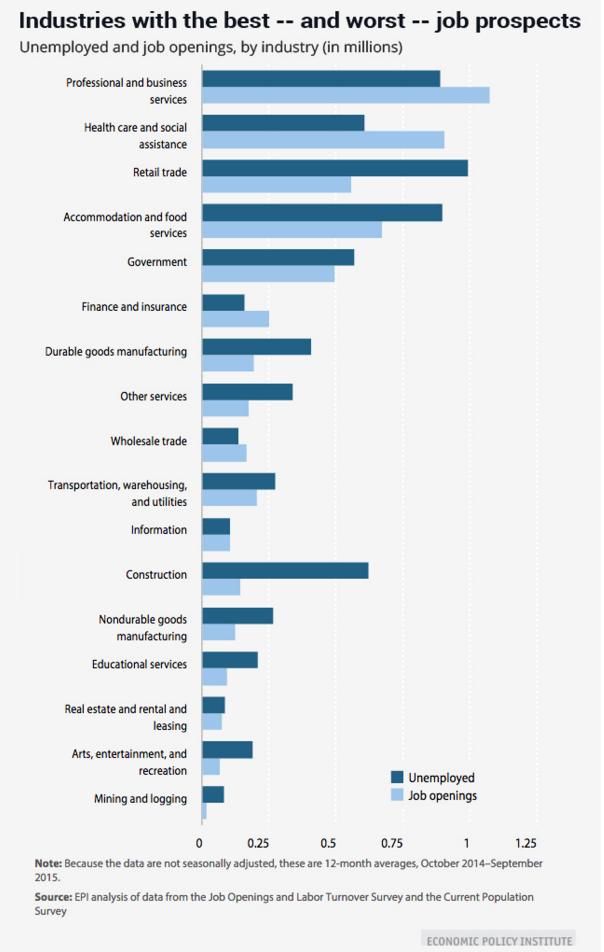
Best and Worst Job Prospects Per Industry

While the government talks about low unemployment figures, there is strong evidence that a lot of people have left the work force thereby artificially lowering the unemployment rate. Before you consider taking on a new career take a look at the following Economic Policy Institute graph illustrating unemployed vs job openings per industry.

Industry Unemployed vs Job Openings