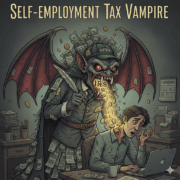
The Self-Employment Tax Vampire: Why an S-Corp Failure is Draining Your Profits
For the profitable business owner or real estate investor, the single most costly tax mistake isn’t an audit—it’s the failure to use the right entity structure. This simple oversight leaves you vulnerable to the Self-Employment (SE) Tax Vampire, which can legally drain 15.3% of your profits year after year.
This article breaks down the S-Corporation structure, the strict rules you must follow, and the common pitfalls that require proactive CPA guidance.
1. The Core Trap: Unnecessary Self-Employment Tax
The primary reason to form an S-Corporation (S-Corp) is to reduce the amount of income subject to the 15.3% Self-Employment (SE) Tax (Social Security and Medicare).
Sole Proprietorship/Single-Member LLC: The Tax Drain
If your profitable business operates as a Sole Proprietorship or a simple Single-Member LLC, 100% of the net profit is subject to the 15.3% SE tax.
The S-Corp Solution: Protection
An S-Corp offers protection because the owner can take money from the business in two forms:
- Salary (W-2 Wages): This portion is subject to the 15.3% FICA/payroll tax (split between the employee/owner and the corporation).
- Distributions: These are the profits paid to you as a shareholder and are not subject to the 15.3% SE tax.
The goal is to optimize the split: pay a reasonable salary, and take the rest as a tax-advantaged distribution.
2. The Strict Rule: Defining Reasonable Compensation
The IRS is highly aware of the incentive to pay a minimal salary and maximize distributions. If challenged, the IRS can reclassify your distributions as wages, subjecting the entire amount to payroll taxes, penalties, and interest.
To stay compliant, the law requires S-Corp shareholder-employees who provide substantial services to the business to receive “Reasonable Compensation”.
How is “Reasonable Compensation” Determined?
There is no fixed formula, but the determination is based on a “facts and circumstances” analysis. If audited, the IRS will evaluate:
- Market Approach: What a comparable business would pay for someone to perform the same services in your industry and geographic area.
- Time and Effort: The specific duties, responsibilities, training, and experience you bring to the business.
- Financial Health: The corporation’s ability to pay the compensation.
3. The Compliance Mandate: Basis Tracking (Form 7203)
For the IRS to accept your deductions, you must be able to prove you have sufficient basis in your S-Corp stock or debt. If you are allocated a loss, the deduction is limited to your total basis.
The Form 7203 Requirement
Starting with the 2021 tax year, S-Corporation shareholders who claim losses or deductions or receive non-dividend distributions are now required to file Form 7203 (S Corporation Shareholder Stock and Debt Basis Limitation) with their personal tax return (Form 1040).
This mandate formalizes the annual basis tracking requirement and gives the IRS a clear digital data point to cross-match, making the risk of an automated audit higher than ever if your basis is inaccurate.
4. Tax Trap: Shareholder Loans and Debt Basis
Shareholder loans to the corporation can be a strategic tool to increase your debt basis and allow you to deduct losses that exceed your stock basis.
However, this strategy carries a major, often overlooked trap:
- The Repayment Trap: If the S-Corp repays a reduced-basis loan (a loan whose basis was lowered because losses were deducted against it) to the shareholder, part or all of that repayment is treated as taxable income. This can generate unexpected ordinary income or capital gains for the shareholder.
- Documentation is Key: To maximize loss deductions and minimize the risk of the loan being reclassified as a disguised distribution (which is immediately taxable), the loan must be formally documented with a written, binding note that outlines terms and interest.
5. W-2 Benefits: S-Corp vs. Sole Proprietorship
Beyond the tax savings, establishing a W-2 salary as an S-Corp shareholder grants access to state and federal safety nets and financial perks that are generally unavailable to pure self-employed sole proprietors.
| Benefit Category | S-Corp Shareholder (W-2 Employee) | Sole Proprietor (Self-Employed) |
| Unemployment Insurance (UI) | W-2 wages in most states qualify for unemployment benefits if the business situation changes. | Generally ineligible for UI benefits based on self-employment earnings. |
| Disability/Family Leave | W-2 wages allow contributions to and eligibility for state-mandated State Disability Insurance (SDI) and Paid Family Leave (PFL) programs, providing replacement income. | Access to these state programs is typically ineligible or requires opting-in and paying the full, higher self-employment rate. |
| Health Insurance | Health insurance premiums paid on behalf of a greater than 2% shareholder are deductible by the S-Corp and included as wages on the owner’s W-2 for income tax purposes, but not subject to FICA/FUTA. | Must take a deduction for the premiums (Self-Employed Health Insurance Deduction) on Form 1040, but does not receive the same favorable employment tax treatment. |
🛑 S-Corp Is Not For You: When the Vampire is a Friend
The S-Corp structure is a powerful tax-saving tool, but it is not suitable for every business owner. Adopting S-Corp status can create new headaches or liabilities if your circumstances don’t align with the strict IRS rules:
- You Are Not Profitable: If your business is consistently operating at a loss, the payroll and compliance costs (Reasonable Compensation, payroll filings) often outweigh the tax savings, as there are no profits to protect from the SE tax.
- Shareholder Limitations: An S-Corp has strict limitations on ownership. It generally cannot have more than 100 shareholders and cannot have C-corporations, partnerships, or certain trusts as shareholders.
- Compliance and Payroll Cost: You must run payroll for yourself, even if you are the only employee. This adds administrative time, complexity, and mandatory costs (payroll services, payroll tax filings) that a simple disregarded entity avoids.
- State Compliance: While federal rules may be advantageous, some states (like California) charge an annual franchise tax simply for maintaining corporate status.
Bonus Planning
The LLC Retroactive S-Corp Election Bonus
If you are currently a profitable LLC operating as a Sole Proprietorship and realized you missed the S-Corp election deadline for the current year, all is not lost. You may be eligible for relief for a late election. An eligible LLC that can show the failure to file Form 2553 on time was due to reasonable cause can request that the S-Corp status be made retroactive to January 1st of the intended tax year. This requires prompt action and an explanation submitted to the IRS.
Call to Action
Don’t wait for the IRS to define your reasonable compensation or deny your loss deductions. Proactive planning is your only defense against the Self-Employment Tax Vampire.
- Contact us today for a complimentary Free Discovery Meeting to discuss your S-Corp setup, conduct a Reasonable Compensation analysis, and ensure your Form 7203 basis is audit-proof.
Contact us at info@mrarrachecpa.com.

About the Author
Michael R. Arrache, CPA, EA, DRE
As a Certified Public Accountant (CPA), Enrolled Agent (EA), and licensed Realtor, I am a tax expert who works closely with small business owners and real estate investors. My firm, Arrache CPA, Inc. dba Mr. Smart Tax, provides a range of specialized financial and real estate services, including tax planning, business transactions, and real estate advisory. With over 15 years of experience, my mission is to help clients achieve their financial and business goals by providing strategic advice and tailored solutions. I write these articles to serve as a starting point to guide you through the business or real estate process, and I am committed to providing the strategic guidance you need to help preserve and grow your wealth.