
Posts

Recap: 2025 Estimated Tax Payments

The deadline for your 2025 Q4 Estimated Tax Payment is January 15, 2026. Missing this date doesn’t just trigger interest—it signals a lack of operational oversight that can lead to costly underpayment penalties.


The Mechanics of Safe Harbor: PY vs. CY

To avoid the IRS underpayment penalty, you must satisfy the “Safe Harbor” requirements. This means paying the lesser of two specific amounts throughout the year.

1. The Current Year (CY) Rule: The 90% Threshold

You must pay at least 90% of the tax liability shown on your 2025 tax return.

  • The Risk: This requires a precise “surgical” estimate of your total 2025 income, including late-year capital gains or business spikes. If you underestimate your total liability, you lose this protection.

2. The Prior Year (PY) Rule: The 100%/110% Floor

This is often the preferred strategy for the Strategic Principal because it provides a fixed, known target based on your 2024 return.

  • Standard Safe Harbor: Pay 100% of the total tax shown on your 2024 return.
  • The “High-Income” Adjustment: If your 2024 Adjusted Gross Income (AGI) was over $150,000 ($75,000 if Married Filing Separately), your Safe Harbor jumps to 110% of your 2024 tax liability.

Strategic Comparison: Which Method to Use?

ScenarioRecommended MethodWhy?
Income is RisingPrior Year (110%)Protects you from penalties on the “excess” profit without tying up extra cash in overpayments.
Income is FallingCurrent Year (90%)Prevents you from overpaying the IRS based on last year’s high margins, keeping capital inside your business.
Unpredictable SpikesPrior Year (110%)Provides an absolute shield against penalties, regardless of how high your 2025 income climbs.

Specialized Exceptions: Farmers and Fishermen

If at least two-thirds of your gross income for 2024 or 2025 is from farming or fishing, you only have one estimated tax payment due date: January 15, 2026. Your Safe Harbor requirement is reduced to 66.67% of your current year tax or 100% of your prior year tax.


The Next Move: Architect Your Final Payment

Estimated taxes are not just a bill; they are a strategic maneuver. Before you hit the January 15 deadline, let’s ensure your payments are optimized for your 2026 growth. Meet your new CPA today—we’re here to help you along the way.

  • Safe Harbor Audit: We can perform a final review of your 2024 vs. 2025 numbers to determine if you are over-allocating capital to the IRS.
  • Underpayment Mitigation: If you missed earlier payments, we can architect a “catch-up” strategy using increased year-end withholding to surgically excise potential penalties.
  • 2026 Cash Flow Planning: Let’s set your quarterly targets for next year now, ensuring your enterprise value isn’t drained by avoidable interest.

About the Author

Michael R. Arrache, CPA & Realtor®

As a Certified Public Accountant (CPA), Enrolled Agent (EA), and licensed Realtor®, Michael is a tax and real estate strategist who specializes in the intersection of business ownership and property investment. His firm provides high-level tax architecture, CFO consulting, and Real Estate strategies for real estate and business owners looking to increase profits and grow their wealth.

With over 15 years of experience, Michael’s mission is to move clients from passive earners to strategic principals in their own financial lives. These publications serve as a guide through the complexities of business and real estate, offering the tailored solutions and strategic oversight needed to secure a multi-generational legacy.


4 Vehicles Types That Save Big On Taxes

When it comes to Saving Money And Reducing Taxes, few tools offer as much immediate impact as the strategic use of vehicle depreciation. However, the IRS does not treat all wheels equally.

Under the One Big Beautiful Bill (OBBB) Act passed in 2025, the landscape for vehicle write-offs has shifted dramatically, particularly with the permanent restoration of 100% bonus depreciation for assets placed in service after January 19, 2025.


The Three Engines of Depreciation

To maximize your deduction, you must understand how these three specific tax “engines” work together.

  1. Section 179 Expensing: This allows you to deduct the full purchase price of a vehicle up to a certain limit in the year of purchase. For 2025, the general limit is $2,500,000, but certain vehicles (like SUVs) are capped at $31,300.
  2. Bonus Depreciation: This is a powerful “kicker” that applies after Section 179. For property placed in service after January 19, 2025, the rate is 100%, meaning you can write off the entire remaining balance of a vehicle’s cost in year one with no dollar cap.
  3. Regular MACRS Depreciation: This is the standard “slow” depreciation spread over five years. Because Section 179 and 100% bonus depreciation now cover most scenarios, MACRS is rarely used for first-year deductions unless a taxpayer specifically elects out of the accelerated options.

Crucial Requirement: For any of these to apply, the vehicle must be used more than 50% for business. If business use is 100%, you get the full deduction; if it’s 60%, you get 60% of the allowable limit.


The 4 Major Vehicle Classifications

The weight of your vehicle is the single most important factor in determining your tax deduction. For tax purposes, “weight” refers to the Gross Vehicle Weight Rating (GVWR), which is the loaded weight (the vehicle plus its maximum safe capacity for passengers and cargo). You can usually find this on a label inside the driver’s side door jamb.

1. Passenger Vehicles (< 6,000 lbs GVWR)

These are standard sedans and small crossovers. Because they are light, they are subject to “Luxury Auto” depreciation caps.

  • Weight Check: Determined by unloaded gross vehicle weight for cars.
  • The Limit: For 2025, the maximum first-year deduction is capped at $20,200 (if bonus depreciation is used) or $12,200 (if not).

2. Light Trucks & Vans (< 6,000 lbs GVWR)

This category includes smaller pickups and delivery vans that don’t hit the heavy-duty threshold.

  • Weight Check: Determined by loaded GVW (GVWR).
  • The Limit: Similar to passenger cars, these are subject to the luxury auto cap of $20,200 in the first year.

3. Heavy Trucks & SUVs (> 6,000 lbs GVWR)

This is the “sweet spot” for many business owners. Vehicles in this class (like a Chevy Tahoe, Ford F-150, or Tesla Model X) are exempt from luxury auto caps.

  • Weight Check: Determined by loaded GVW (GVWR).
  • The SUV Catch: SUVs in this weight class are limited to a $31,300 Section 179 deduction. However, you can then apply 100% bonus depreciation to the remaining balance, effectively writing off the entire vehicle in year one.
  • The Truck Advantage: Pickups with a cargo bed of at least six feet (measured with the tailgate up) are not considered SUVs and can use the full $2.5 million Section 179 limit directly.

4. Specialized & Heavy Commercial Vehicles (> 14,000 lbs GVWR)

These are true workhorses—dump trucks, large freight trucks, and specialized vocational vehicles.

  • Weight Check: Determined by loaded GVW (GVWR).
  • The Limit: These vehicles are entirely exempt from SUV and luxury auto caps. They qualify for the full $2.5 million Section 179 deduction and 100% bonus depreciation without restriction.

Strategic Comparison Table

Vehicle TypeWeight Metric2025 First-Year Max Deduction
Small CarUnloaded < 6k lbs$20,200
Heavy SUVLoaded 6k–14k lbs100% of cost (via 179 + Bonus)
Heavy Truck (6ft+ Bed)Loaded > 6k lbs100% of cost (Full Sec 179)
Commercial VehicleLoaded > 14k lbs100% of cost (No limits)

Ready to Maximize Your Vehicle Write-Off?

If you recently purchased a business vehicle or are planning to head to the dealership soon, let’s ensure you aren’t leaving money on the table.

  • Pre-Purchase Consultation: Schedule a consultation with us ASAP to review the specific models you are considering. We will help you verify the GVWR and “Cargo Bed” requirements so you make the best decision for your taxes before you drive off the lot.
  • Post-Purchase Audit: If you’ve already acquired a vehicle, we can review the purchase agreement to determine if you qualify for 100% Bonus Depreciation or Section 179 expensing to maximize your immediate cash flow.
  • CFO Oversight: We can architect a fleet or vehicle strategy that balances operational needs with long-term tax optimization and asset protection.

About the Author

Michael R. Arrache, CPA & Realtor®

As a Certified Public Accountant (CPA), Enrolled Agent (EA), and licensed Realtor®, Michael is a tax and real estate strategist who specializes in the intersection of business ownership and property investment. He provides high-level tax planning, CFO consulting, and Real Estate strategies for real estate and business owners looking to increase profits and grow their wealth.

With over 15 years of experience, Michael’s mission is to move clients from passive earners to strategic principals in their own financial lives. These publications serve as a guide through the complexities of business and real estate, offering the tailored solutions and strategic oversight needed to secure a multi-generational legacy.

What is a Trump Account?

Established as a new type of tax-advantaged investment vehicle for U.S. children, a Trump Account functions similarly to a traditional IRA until the beneficiary reaches adulthood.

The Core Mechanics

  • The Government Seed: Every U.S. citizen born between January 1, 2025, and December 31, 2028, qualifies for a one-time $1,000 government contribution.
  • The “Growth Period”: The account is managed by an “authorized individual” (typically a parent or guardian) until December 31st of the year before the child turns 18.
  • No Early Access: Funds generally cannot be withdrawn before the year the child turns 18, except for death or specific rollovers to an ABLE account for children with disabilities at age 17.
  • Investment Guardrails: By law, funds must be invested in low-cost U.S. equity index funds (e.g., S&P 500). Annual fees are strictly capped at 0.10% of the account balance.

Contribution Limits and Strategy

While the government provides the starter, the real power lies in the annual contribution capacity from private sources.

  • Annual Cap: Families, friends, and others can contribute up to $5,000 per year per child. This limit will be indexed for inflation starting in 2028.
  • The Employer Benefit: Employers can contribute up to $2,500 annually toward an employee’s dependent child’s Trump Account. These contributions are excluded from the employee’s taxable income.
  • Philanthropic “Top-Offs”: Private donations are already supercharging these accounts. A $6.25 billion pledge from Michael and Susan Dell aims to provide an additional $250 to 25 million children aged 10 and under in qualifying income areas.

Important Dates and Deadlines

You cannot fund these accounts immediately, but you should prepare your filings now to claim the government seed.

  • Claiming the $1,000 Seed: Parents can make the election by filing IRS Form 4547. This can be filed alongside your 2025 income tax return in early 2026.
  • Account Activation: The Treasury Department will begin sending activation instructions in May 2026.
  • First Contributions: Private and employer contributions will officially be accepted starting on July 4, 2026.

Arrache PC Advisory: Trump Account vs. 529 Plan

It is important to remember that a Trump Account does not replace a 529 Plan; it complements it.

FeatureTrump Account529 College Savings Plan
Primary GoalGenerational Wealth / RetirementEducation Expenses
Tax TreatmentTax-Deferred (Taxed as ordinary income later)Tax-Free (For qualified education)
Contribution Limit$5,000/year (Aggregate)Varies by State (Often $300k+ total)
Withdrawal AgeRestricted until 18No age limit (linked to expenses)
Post-18 StatusConverts to Traditional IRARemains a 529 or Roth IRA Rollover

Next Steps for 2026

For families looking to maximize this “low-friction” win for their estate plan, we recommend three immediate actions:

  1. Prepare Form 4547: Ensure your tax preparer has the valid Social Security numbers for your qualifying children to claim the seed money on your upcoming return.
  2. Evaluate Employer Benefits: If you are a business owner, consider adopting a written Trump Account contribution plan to offer this tax-free benefit to your employees.
  3. Audit Your Legacy Plan: As these accounts eventually convert to Traditional IRAs, we need to ensure they align with your broader succession and multi-generational wealth goals.

Don’t leave government and philanthropic money on the table. Schedule a consultation with Michael Arrache to integrate Trump Accounts into your 2026 wealth architecture.


About the Author

Michael R. Arrache, CPA, EA, DRE

As a Certified Public Accountant (CPA), Enrolled Agent (EA), and licensed Realtor, I am a tax expert who works closely with small business owners and real estate investors. My firm, Arrache CPA, Inc. dba Mr. Smart Tax, provides a range of specialized financial and real estate services, including tax planning, business transactions, and real estate advisory. With over 15 years of experience, my mission is to help clients achieve their financial and business goals by providing strategic advice and tailored solutions. I write these articles to serve as a starting point to guide you through the business or real estate process, and I am committed to providing the strategic guidance you need to help preserve and grow your wealth.

The $Mistake: Why Your “Charity” is Actually a Taxable Business

The Line in the Sand: Nonprofit vs. Business

Every founder with a mission dreams of tax-exempt status. But the path to becoming a recognized public charity 501(c)(3) is fraught with strict legal and financial tests. The true cost of seeking nonprofit status isn’t the filing fee—it’s the risk of having a profitable business structure that fails the charity test entirely.

If you started your organization hoping for tax-exempt status but were denied, or if you realize your current operations would likely lead to a denial—you are running a compromised entity. Your organization is legally exposed, and you need an immediate strategy shift.

The case study of “Organization A“, an entity attempting to navigate the complex world of state-funded specialized care, illustrates this perfectly. They learned the hard way that if the company’s primary function is private benefit or not related to public charity, the IRS will deny its mission—forcing a dramatic and costly pivot.


Establishing a Compliant Nonprofit (The 5 Key Steps)

Before all else, you must define your public charity mission. This mission will guide every legal and financial step that follows.

  1. State Incorporation (CA SOS): File the Articles of Incorporation (e.g., Form ARTS-PB) with the California Secretary of State (SOS). This legally creates the corporation as a Nonprofit Public Benefit entity.
  2. Federal EIN: Obtain an Employer Identification Number (EIN) from the IRS. This number is required for all bank accounts, tax filings, and payroll.
  3. CA Charitable Registration (CA AG): Register with the California Attorney General’s (AG) Registry of Charities and Fundraisers. This is mandatory within 30 days of first receiving charitable assets (donations, grants).
  4. Federal Tax Exemption (IRS): File IRS Form 1023 (Application for Recognition of Exemption Under Section 501(c)(3)) or Form 1023-EZ. Approval here grants federal tax-exempt status.
  5. State Tax Exemption (FTB): File Form 3500 or Form 3500A with the California Franchise Tax Board (FTB). This is the California equivalent of the Form 1023, granting exemption from state corporate income tax.

Three Fatal Flaws that Kill a Nonprofit Application

The IRS operates on two core principles: Prohibition of Inurement and the Operational Test. Any public charity must pass both. “Organization A” failed spectacularly on multiple fronts, exposing the following “fatal flaws”:

1. The Indefensible Insider Salary (Prohibited Inurement)

The single quickest way to ensure denial is to pay a founder or insider an excessive salary. Prohibited private inurement occurs when a charity’s net earnings are used to unjustly enrich an insider.

  • The “Organization A” Case Study: The Founder was paid excessive compensation for providing services. Since the organization operated without a robust public program, this payment was deemed unjustified and not substantiated by market rates for the service rendered.
  • The CPA’s Warning: Compensation must be reasonable—meaning it must be comparable to what a similar professional in a comparable organization would be paid. Without this proof, the IRS classifies the excessive payment as an Excess Benefit Transaction, which leads to denial and potential personal penalties for the founder.
2. The 100% Private Benefit Trap (The Operational Test)

A 501(c)(3) must be operated exclusively for charitable purposes, meaning its public activities must be substantial.

  • The “Organization A” Case Study: A high percentage of the organization’s total revenue came from a single private funding stream linked to the care of a Related Adult Beneficiary. This proved the organization’s primary function was to sustain a private, familial employment arrangement, not serve the general public.
  • The Rule: Even with volunteer work, if all the organization’s paid resources are concentrated on a private interest, the IRS concludes the charitable mission is merely a “pretext”.
3. Structural Non-Compliance

The nonprofit organization’s failure to establish basic operating procedures sank the application:

  • The organization could not provide documentation, detailed Program Policies, or a budget for its stated charitable missions.
  • The high-hour compensation claimed lacked essential labor law justification, exposing the directors to personal liability for wage and hour disputes under state law.

The Only Two Viable Paths for Mission-Driven Entities

If your organization has already been denied tax-exempt status or is preparing to apply but is currently compromised because its operations involves related party revenue, specialized services, or high founder compensation, you must choose one of the following compliant paths:

Path A: The Clean Break (Recommended)

This strategy separates the profitable, high-risk operational business from the clean, public charitable function. This is the ultimate lesson learned by “Organization A”.

  1. Close the Compromised Entity: Dissolve the old nonprofit entity (“Organization A”) immediately. File final corporate tax returns (Form 1120/100) to clear all tax history and obtain tax clearance, avoiding the complex conversion process.
  2. Form a Taxable Business: Create a new, taxable S-Corporation to handle all fee-for-service work (like contract administration and payroll). This structure provides the necessary corporate liability protection and allows the founder to receive a salary without violating inurement laws.
  3. Form a Pure Nonprofit: Create a separate, new public charity with a new EIN immediately. This entity must have zero financial history with the founder’s business dealings. Its sole purpose is to raise funds and run the public programs.
Path B: The Correct Nonprofit Structure

If an entity absolutely must be a nonprofit to function (e.g., a hospital or university), all compensation must be carefully managed.

  • Third-Party Benchmarking: Compensation for insiders must be determined by a disinterested board based on external, third-party salary surveys of comparable positions.
  • Zero Related-Party Revenue: The organization must demonstrate its financial support comes primarily from the public (donations, grants, public program fees) and that services provided to any insider or their family member are incidental to the overall mission.

Final Advice: Never Let Operations Go Uncertified

The key takeaway from this case study is to know your operations.  You must be able to certify all your business practices in order to clearly identify and avoid risks. 

If you’re concerned that your nonprofit structure is a high risk, do not guess or stall, reach out to us today for a free introductory discovery consultation

Contact us at Info@mrarrachecpa.com 


About the Author

Michael R. Arrache, CPA, EA, DRE

As a Certified Public Accountant (CPA), Enrolled Agent (EA), and licensed Realtor, I am a tax expert who works closely with nonprofits, small business owners and real estate investors. My firm, Arrache CPA, Inc. dba Mr. Smart Tax, provides a range of specialized financial and real estate services, including tax planning, business transactions, and real estate advisory. With over 15 years of experience, my mission is to help clients achieve their financial and business goals by providing strategic advice and tailored solutions. I write these articles to serve as a starting point to guide you through the business or real estate process, and I am committed to providing the strategic guidance you need to help preserve and grow your wealth.

Buying a Commercial Auto Repair Shop: Case Study on Potential Traps and How to Do it Right

The journey to buying a business is often stressful, but the risks multiply when you skip critical financial steps and lack your own fiduciary representation. As CPAs and Real Estate Brokers, we’ve seen it all—and sometimes, the most valuable service we provide is telling a client to walk away.

We recently handled a complex case for a buyer we’ll call “Grease Lightning” (a seasoned mechanic) and his wife, “Cash Flow Clara” (a dedicated nurse), who were determined to buy a local auto shop, let’s call it, “The Dirty Wrench Garage”. Despite their enthusiasm, their deal nearly imploded because they ignored the structural and financial red flags we identified.

This detailed case study is your roadmap to doing it right, showing exactly where a seller’s broker can steer you into disaster.


Case Study: The Deal’s Fatal Flaws and The Seller’s Broker Trap

The buyer was rushed by the seller’s broker to sign a Letter of Intent (LOI) on the The Dirty Wrench garage for $275,000, initiating a pressured sprint toward closing. Since the buyer was unrepresented, the LOI was prepared by the seller’s broker and designed to strip the buyer of leverage and protection immediately. Here is what our CPA due diligence uncovered, based on the terms of that one-sided LOI:

The Buyer’s Fatal Lack of Preparation

The buyer signed the LOI without performing essential preliminary and follow-up steps: They had not been pre-qualified by a commercial lender, had not seen the new lease, and had not met with or spoken to the landlord about future lease terms. This negligence made them vulnerable to every flaw below.

1. The Fatal Structural Flaw: Lease vs. Loan

This is the most critical mistake, guaranteeing future financial instability.

  • Loan Term Risk: The LOI requires Financing of $200,000 amortized over 5 years.
  • Lease Term Gap: The lease contingency only required a new commercial lease for a term of at least 3 years.
  • The Disaster: The buyer risked having a $200,000 loan balance with no guaranteed location to operate the business for the final two years of the financing term.

2. The Deposit Trap & Seller Broker Steering

The seller’s broker, who had not signed a buyer representation agreement or dual agency disclosure (per user context), leveraged the buyer’s enthusiasm against their financial security.

  • Premature Loss: The LOI made the $10,000 deposit non-refundable which is highly problematic and is structured backward compared to standard commercial practices. With contingencies that are vague and do not adequately protect the $10,000 deposit, the LOI is structured specifically to make the deposit non-refundable prematurely. The LOI places the buyer at extreme risk.
  • The Risk: This structure unethically pressured the buyer into risking their $10,000 before securing final SBA financing approval or a fully executed lease, completely contradicting the purpose of the contingencies. The current LOI’s structure makes it likely the deposit will be lost if the lease or loan falls apart after the deposit has been committed.
  • Broker Steering: This pressure, combined with the structural flaws in the deal, highlighted the potential for unethical steering designed to misrepresent the buyer in favor of the seller and close a fundamentally broken deal.

3. Financial Risks & Skewed Tax Allocation (PPA)

Our review of the financials and the Preliminary Allocation of Purchase Price (PPA) showed the deal was fundamentally broken and structured to the buyer’s tax disadvantage:

  • Business Over Valued: Review of the tax documents showed over -$113,000 in prior accumulated losses and a net loss in the most recent year. The asking price was grossly inflated with $150,000 of worthless Goodwill.
  • Audit Risk (The Inherited Liability): We found evidence of excessive purchases related to income (high Cost of Goods Sold) and potential unreported cash sales. When we brought this liability to the buyer’s attention, they relayed that The Seller’s Broker had specifically advised them that these unreported cash sales represented additional value. This pressure from the broker to accept illegal activity meant the buyers were being steered into purchasing (going into debt to buy) a business history that could be flagged for a severe IRS or state sales tax audit immediately after closing.
  • Adverse Tax Structure: The LOI allocated a staggering $150,000 (54.5% of the price) to Goodwill. This is highly disadvantageous for the buyer because Goodwill must be amortized over 15 years, providing a slow tax benefit. Furthermore, while the PPA allocated $100,000 to equipment (good for tax purposes), the actual book value of the equipment was only $73,000, meaning the buyer was overpaying for the asset by $27,000.

The Outcome: The clients relied on our professional advice that saved them from purchasing (borrowing money to buy) a fundamentally broken and high-risk business, driven by a tight timeline and the pressure from the seller’s unethical broker.


The Correct 7-Step Process for Buying a Commercial Business

You must secure your representation and finances before committing any capital. This seven-step process minimizes risk and maximizes your leverage:

Phase 1: Preparation and Strategy

  1. Retain Your CPA (Financial Fiduciary): This is the crucial first step. Hire a CPA to establish the correct Purchase Price Allocation (PPA) to maximize your tax deductions and execute all financial due diligence (reviewing tax returns, verifying true value, identifying audit risks). The CPA acts solely as a financial fiduciary for the buyer.
  2. Retain Your Broker (Transaction Fiduciary): Next, hire a real estate/business broker to handle the transaction-specific negotiation, manage the escrow process, and ensure all non-financial contingencies (lease terms, physical assets) are met. The broker acts as a transaction fiduciary who manages the deal on your behalf.
  3. Financial Pre-Qualification: Meet with a commercial lender (like an SBA specialist) and get a solid pre-qualification letter confirming the maximum loan amount you can secure.
  4. Research & Select Targets: Identify your top 3–5 buying opportunities to maintain leverage throughout the negotiation process.

Phase 2: Engagement and Negotiation

  1. Submit LOIs (Contingent Offers): Send non-binding Letters of Intent (LOIs) for your top choices. Crucially, ensure the LOI makes the deposit 100% refundable until all contingencies (Lease, Financing, Due Diligence) are removed.
  2. Eliminate & Negotiate: Demand full financial and operational documents from the seller. This phase involves setting non-negotiable terms: reduce Goodwill, reduced price, adequate financing terms and a definitive lease term that protects your business operation.

Phase 3: Due Diligence & Closing

  1. Open Escrow with Contingencies: Deposit funds into escrow. The deposit remains refundable while we execute the non-negotiable reviews:
    • Financial Due Diligence (CPA): Review full tax returns and verify true business value.
    • Lease Review (Real Estate Broker/Attorney): Confirm the landlord will agree to a lease term that matches or exceeds your loan term (e.g., a 5-year loan requires a 5-year lease plus options).
    • Asset Purchase Agreement (APA) Review: Finalize the list of assets and ensure the final PPA is structured correctly for tax savings.
    • Close Escrow: Once all contingencies are removed, the deposit becomes non-refundable, and the transaction closes.

The outcome of “The Dirty Wrench Garage” case proves that without a strong, financially-minded advisor, even the most promising opportunity can become a costly mistake. Don’t let a fast timeline or high-pressure Seller tactics override a sound process.

Call to Action

Ready to buy or sell your business the right way? Contact us today to ensure your next transaction is structured for maximum profit and minimum risk.

Contact us at info@mrarrachecpa.com

About the Author

Michael R. Arrache, CPA, EA, DRE

As a Certified Public Accountant (CPA), Enrolled Agent (EA), and licensed Realtor, I am a tax expert who works closely with small business owners and real estate investors. My firm, Arrache CPA, Inc. dba Mr. Smart Tax, provides a range of specialized financial and real estate services, including tax planning, business transactions, and real estate advisory. With over 15 years of experience, my mission is to help clients achieve their financial and business goals by providing strategic advice and tailored solutions. I write these articles to serve as a starting point to guide you through the business or real estate process, and I am committed to providing the strategic guidance you need to help preserve and grow your wealth.

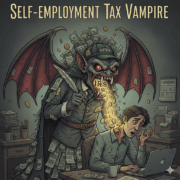
The Self-Employment Tax Vampire: Why an S-Corp Failure is Draining Your Profits

For the profitable business owner or real estate investor, the single most costly tax mistake isn’t an audit—it’s the failure to use the right entity structure. This simple oversight leaves you vulnerable to the Self-Employment (SE) Tax Vampire, which can legally drain 15.3% of your profits year after year.

This article breaks down the S-Corporation structure, the strict rules you must follow, and the common pitfalls that require proactive CPA guidance.


1. The Core Trap: Unnecessary Self-Employment Tax

The primary reason to form an S-Corporation (S-Corp) is to reduce the amount of income subject to the 15.3% Self-Employment (SE) Tax (Social Security and Medicare).

Sole Proprietorship/Single-Member LLC: The Tax Drain

If your profitable business operates as a Sole Proprietorship or a simple Single-Member LLC, 100% of the net profit is subject to the 15.3% SE tax.

The S-Corp Solution: Protection

An S-Corp offers protection because the owner can take money from the business in two forms:

  1. Salary (W-2 Wages): This portion is subject to the 15.3% FICA/payroll tax (split between the employee/owner and the corporation).
  2. Distributions: These are the profits paid to you as a shareholder and are not subject to the 15.3% SE tax.

The goal is to optimize the split: pay a reasonable salary, and take the rest as a tax-advantaged distribution.


2. The Strict Rule: Defining Reasonable Compensation

The IRS is highly aware of the incentive to pay a minimal salary and maximize distributions. If challenged, the IRS can reclassify your distributions as wages, subjecting the entire amount to payroll taxes, penalties, and interest.

To stay compliant, the law requires S-Corp shareholder-employees who provide substantial services to the business to receive “Reasonable Compensation”.

How is “Reasonable Compensation” Determined?

There is no fixed formula, but the determination is based on a “facts and circumstances” analysis. If audited, the IRS will evaluate:

  • Market Approach: What a comparable business would pay for someone to perform the same services in your industry and geographic area.
  • Time and Effort: The specific duties, responsibilities, training, and experience you bring to the business.
  • Financial Health: The corporation’s ability to pay the compensation.

3. The Compliance Mandate: Basis Tracking (Form 7203)

For the IRS to accept your deductions, you must be able to prove you have sufficient basis in your S-Corp stock or debt. If you are allocated a loss, the deduction is limited to your total basis.

The Form 7203 Requirement

Starting with the 2021 tax year, S-Corporation shareholders who claim losses or deductions or receive non-dividend distributions are now required to file Form 7203 (S Corporation Shareholder Stock and Debt Basis Limitation) with their personal tax return (Form 1040).

This mandate formalizes the annual basis tracking requirement and gives the IRS a clear digital data point to cross-match, making the risk of an automated audit higher than ever if your basis is inaccurate.


4. Tax Trap: Shareholder Loans and Debt Basis

Shareholder loans to the corporation can be a strategic tool to increase your debt basis and allow you to deduct losses that exceed your stock basis.

However, this strategy carries a major, often overlooked trap:

  • The Repayment Trap: If the S-Corp repays a reduced-basis loan (a loan whose basis was lowered because losses were deducted against it) to the shareholder, part or all of that repayment is treated as taxable income. This can generate unexpected ordinary income or capital gains for the shareholder.
  • Documentation is Key: To maximize loss deductions and minimize the risk of the loan being reclassified as a disguised distribution (which is immediately taxable), the loan must be formally documented with a written, binding note that outlines terms and interest.

5. W-2 Benefits: S-Corp vs. Sole Proprietorship

Beyond the tax savings, establishing a W-2 salary as an S-Corp shareholder grants access to state and federal safety nets and financial perks that are generally unavailable to pure self-employed sole proprietors.

Benefit CategoryS-Corp Shareholder (W-2 Employee)Sole Proprietor (Self-Employed)
Unemployment Insurance (UI)W-2 wages in most states qualify for unemployment benefits if the business situation changes.Generally ineligible for UI benefits based on self-employment earnings.
Disability/Family LeaveW-2 wages allow contributions to and eligibility for state-mandated State Disability Insurance (SDI) and Paid Family Leave (PFL) programs, providing replacement income.Access to these state programs is typically ineligible or requires opting-in and paying the full, higher self-employment rate.
Health InsuranceHealth insurance premiums paid on behalf of a greater than 2% shareholder are deductible by the S-Corp and included as wages on the owner’s W-2 for income tax purposes, but not subject to FICA/FUTA.Must take a deduction for the premiums (Self-Employed Health Insurance Deduction) on Form 1040, but does not receive the same favorable employment tax treatment.

🛑 S-Corp Is Not For You: When the Vampire is a Friend

The S-Corp structure is a powerful tax-saving tool, but it is not suitable for every business owner. Adopting S-Corp status can create new headaches or liabilities if your circumstances don’t align with the strict IRS rules:

  • You Are Not Profitable: If your business is consistently operating at a loss, the payroll and compliance costs (Reasonable Compensation, payroll filings) often outweigh the tax savings, as there are no profits to protect from the SE tax.
  • Shareholder Limitations: An S-Corp has strict limitations on ownership. It generally cannot have more than 100 shareholders and cannot have C-corporations, partnerships, or certain trusts as shareholders.
  • Compliance and Payroll Cost: You must run payroll for yourself, even if you are the only employee. This adds administrative time, complexity, and mandatory costs (payroll services, payroll tax filings) that a simple disregarded entity avoids.
  • State Compliance: While federal rules may be advantageous, some states (like California) charge an annual franchise tax simply for maintaining corporate status.

Bonus Planning

The LLC Retroactive S-Corp Election Bonus

If you are currently a profitable LLC operating as a Sole Proprietorship and realized you missed the S-Corp election deadline for the current year, all is not lost. You may be eligible for relief for a late election. An eligible LLC that can show the failure to file Form 2553 on time was due to reasonable cause can request that the S-Corp status be made retroactive to January 1st of the intended tax year. This requires prompt action and an explanation submitted to the IRS.


Call to Action

Don’t wait for the IRS to define your reasonable compensation or deny your loss deductions. Proactive planning is your only defense against the Self-Employment Tax Vampire.

  • Contact us today for a complimentary Free Discovery Meeting to discuss your S-Corp setup, conduct a Reasonable Compensation analysis, and ensure your Form 7203 basis is audit-proof.

Contact us at info@mrarrachecpa.com.

About the Author

Michael R. Arrache, CPA, EA, DRE

As a Certified Public Accountant (CPA), Enrolled Agent (EA), and licensed Realtor, I am a tax expert who works closely with small business owners and real estate investors. My firm, Arrache CPA, Inc. dba Mr. Smart Tax, provides a range of specialized financial and real estate services, including tax planning, business transactions, and real estate advisory. With over 15 years of experience, my mission is to help clients achieve their financial and business goals by providing strategic advice and tailored solutions. I write these articles to serve as a starting point to guide you through the business or real estate process, and I am committed to providing the strategic guidance you need to help preserve and grow your wealth.

From a Panera Table to a Global Reach: Celebrating 12 Years of Growth


Twelve years ago, our business began with a simple idea and a lot of determination.

Our office wasn’t a sleek corporate space; it was a kitchen table, a public library, and sometimes, a quiet corner at Panera Bread with free Wi-Fi. Our client list was humble—one dedicated restaurant owner and a handful of individuals who put their trust in us.

Today, as we celebrate our 12th anniversary, we are humbled and incredibly proud to say we serve hundreds of business owners and real estate investors not just across the country, but around the world. That small handful of clients has grown into a thriving community, and we wouldn’t be here without each and every one of you.


A Landmark Year of Service

The past year has been a landmark for our firm. We’ve invested heavily in our team, focusing on new skill training and bringing on new talent to ensure we provide the highest level of expertise. As we continue to grow, we’ve formalized our expertise into a set of services designed to help you succeed.

Our Real Estate Expertise

We’ve honed our expertise to offer a unique, comprehensive real estate service. We can act as your trusted financial consultant, providing essential guidance on everything from tax implications and cash flow analysis to accounting and long-term planning. We can also serve as your dedicated realtor, offering full-service representation for buying, selling, or leasing properties. Our hands-on experience ranges from revitalizing major residential properties to spearheading new property developments and navigating the sale of commercial buildings, allowing us to serve you with real-world knowledge and seamless, integrated advice.

Embracing the Future: Technology and AI

We were at the forefront of the new tax laws under OBBBA, providing our clients with early-stage guidance and implementation to help them navigate the changes successfully. As we look ahead, we are embracing the coming AI-powered revolution by implementing new software and technology that will improve our capabilities and allow us to serve you even more efficiently.

This year, we have implemented new client facing technology, which offers better user experience and helps us serve you more efficiently. While this implementation has been beneficial in streamlining our work, we understand that with every new software, there is a learning curve. Please know that we are here to help you with any questions and to find the best way to communicate with you, ensuring a smooth and productive experience.

Introducing a New Resource for Restaurant Owners

Our journey began with a single restaurant owner, and that community remains at the heart of what we do. In 2025, we had the privilege of helping clients in a variety of ways: guiding a San Diego restaurant through a complex lease exit and asset sale, assisting another with a successful rebranding strategy, and providing the crucial financial planning and operational strategies needed to build out a new space and thrive in seasonal markets.

Now, we’re thrilled to give back to this community with the upcoming release of our self-published guide, The Bean Counter’s Bible for Restaurants. This guide is the ultimate source for all things financial and operational, providing restaurant owners with the knowledge they need to successfully start, run, grow, or sell their business.


Our journey from that first client to a global presence is a testament to our commitment to your success. We are dedicated to continuing to grow our team and our capabilities to better serve you as your trusted CPA professionals and real estate advisors.

Thank you for being a part of our story. We can’t wait to see what the next 12 years bring.

Newport Beach Investors Caught in Diamond Ponzi Scheme: Tax Implications of Their Loss

Newport Beach, California, a hub of affluent investors, has recently seen several individuals fall victim to a sophisticated diamond investment scheme that has since been exposed as a multi-million dollar Ponzi. (full article here) The elaborate fraud, perpetrated by a local dealer, promised exorbitant returns on high-value diamond acquisitions, luring unsuspecting investors with the allure of a seemingly tangible and exclusive asset. As the dust settles and the true nature of the operation comes to light, many victims are now grappling with significant financial losses. However, there may be a silver lining in the form of tax relief, specifically the ability to write off these losses against ordinary income.

The Anatomy of the Diamond Ponzi

The fraudulent scheme, reportedly orchestrated by a well-known local diamond dealer, capitalized on the perceived stability and value of diamonds. Investors were presented with meticulously crafted prospectuses detailing opportunities to purchase rare and investment-grade diamonds, with promises of substantial profits upon resale within a short timeframe. The dealer allegedly used funds from new investors to pay off earlier investors, creating the illusion of a legitimate and profitable enterprise. This classic Ponzi model inevitably collapsed, leaving a trail of shattered dreams and depleted bank accounts. Investigations are ongoing, and legal proceedings are anticipated against the alleged perpetrator.

Understanding Tax Deductions for Ponzi Scheme Losses

For victims of Ponzi schemes, the Internal Revenue Service (IRS) offers specific guidance and relief regarding the tax treatment of their losses. Generally, investment losses are treated as capital losses, which have limitations on how much can be deducted against ordinary income in a given year. However, for losses stemming from a theft, such as a Ponzi scheme, the IRS provides a more favorable treatment, allowing for a deduction against ordinary income.

Theft losses are not subject to the $3,000 annual limit that typically applies to capital losses, making this deduction significantly more valuable for Ponzi scheme victims. Also, for tax years 2018 through 2025, an individual can only deduct theft losses if the loss is from a transaction entered into for profit, which a fraudulent investment scheme qualifies as.

Two Paths to Claiming Your Loss

The IRS provides two primary ways for victims of this scheme to claim their deduction.


Path 1: The IRS Safe Harbor (The Easiest Method)

Recognizing the difficulty in proving the exact nature and timing of a Ponzi scheme loss, the IRS created a “safe harbor” in Revenue Procedure 2009-20. This simplifies the process for victims. To use this safe harbor, you would generally claim the loss in the year the scheme’s lead figure is indicted or a criminal complaint is filed against them.

Under the safe harbor, you can deduct a percentage of your “qualified investment”. The deductible amount is calculated as follows:

  • 95% of your qualified investment if you do not pursue any recovery from a third party (like an accountant or lawyer).
  • 75% of your qualified investment if you are pursuing or plan to pursue third-party recovery.

The qualified investment includes the total amount of cash or property you invested, plus any fictitious income you reported on past tax returns, minus any cash or property you received back.

This deduction is filed on Form 4684, Casualties and Thefts, and you must include a statement with your tax return that you are electing the safe harbor.


Path 2: The 100% Deduction (The More Complex Method)

If you want to deduct 100% of your loss, you must forgo the safe harbor and claim the loss under the general tax rules of Internal Revenue Code (IRC) Section 165. This method is more complex and has a higher burden of proof.

You can only deduct the loss in the year you discover it and also determine there is no reasonable prospect of recovery. Proving this to the IRS can be very difficult, as it requires you to show with certainty that you will not recover any funds from the scheme’s assets or any legal claims. The IRS safe harbor was specifically created to bypass this difficult process by allowing an immediate deduction (at 95% or 75%) without requiring proof of a lack of recovery.


Comparison of the Two Methods

FeatureIRS Safe Harbor (Rev. Proc. 2009-20)General Rules (IRC § 165)
Deduction Amount95% or 75% of qualified investment.Up to 100% of the qualified investment.
Required ProofRelatively simple; requires an indictment or criminal complaint against the lead figure.Highly complex; requires you to prove “no reasonable prospect of recovery”.
Deduction TimingClaimed in the year of the promoter’s indictment or complaint.Claimed only when it can be determined there is no reasonable prospect of any recovery. This could be years later.
Filing ProcessSimplified with specific instructions on Form 4684 and a signed statement.Requires detailed documentation and proof to support a 100% loss.

Next Steps

Given the complexities of this type of tax deduction, it is crucial to ensure you are following the correct procedures to maximize your recovery. If you have been a victim of the Lugano Diamonds scheme or a similar fraudulent investment, I can help you:

  • Determine your qualified investment and the correct deductible loss amount.
  • Properly document and file your tax return with the required forms.
  • Navigate the process of carrying back a Net Operating Loss to get a refund.

Please feel free to contact me for a confidential consultation to discuss your specific situation and ensure you receive the tax relief you are entitled to. Michael@mrarrachecpa.com or 949-877-3143

The Smart Family Loan: Why a Promissory Note is Essential (Even for Family!)

That moment when a relative steps in to help their family business is truly special. It’s a testament to family support, trust, and love. Recently, I had a client, whose relative generously lent them a large amount of money to help open their business. While the gesture was heartwarming, my immediate advice was clear: Get a promissory note signed.

You might be thinking, “It’s family! Does it really need to be so formal?” And my answer as a CPA is an unequivocal yes. A promissory note isn’t about distrust; it’s about smart financial planning, clear communication, and protecting both parties.

Let’s break down why this simple document is a must for any family loan:


The Promissory Note Checklist: What Needs to Be in It?

Think of a promissory note as the blueprint for your loan. It should clearly lay out all the terms to prevent any future confusion. Here’s what it should include:

  • Lender and Borrower Information: Full legal names and addresses for both your relative (the lender) and you (the borrower).
  • Principal Amount: The exact loan amount, written in both numbers and words.
  • Interest Rate: This is crucial! To avoid the IRS classifying the loan as a gift, the rate must be at least the Applicable Federal Rate (AFR), which changes monthly. We can look up the current rate together.
  • Repayment Schedule: Details on how and when payments will be made – monthly, quarterly, or a single lump sum, and specific due dates.
  • Maturity Date: The final date by which the entire loan, including interest, must be repaid.
  • Signature and Date: Both parties need to sign and date the note to make it legally binding.
  • Default Clause: What happens if payments are missed? This clause protects your relative and clarifies the process.
  • Prepayment Clause: Allows you to pay off the loan early without penalty – a common and fair clause for family loans.

The Pros of a Promissory Note: More Than Just Paperwork

Now, let’s talk about the significant benefits this document provides:

1. Legal and Financial Protection for Everyone

  • Avoids Nasty Tax Surprises: Without a note, the IRS might consider the money a gift from your relative. This could trigger gift tax liabilities for them on any amount over the annual exclusion limit. A promissory note provides undeniable proof it’s a loan.
  • The “Bad Debt” Lifeline: This is a big one! If, for unforeseen reasons, you are unable to repay the loan, the promissory note becomes critical documentation for your relative. It allows them to potentially claim a non-business bad debt deduction on their taxes. Without the note, the IRS would likely view the unpaid amount as an unrecoverable gift, and they’d lose out on that deduction.
  • Legal Enforceability: It’s a legally binding agreement. While no one wants to think about legal action against family, having this in place protects your relative’s assets.
  • Asset Protection for Both: In unfortunate events like bankruptcy or divorce, a promissory note clearly establishes the funds as a legitimate debt, protecting both your relative’s claim and your financial standing.

2. Crystal-Clear Clarity and Accountability

  • No More “He Said, She Said”: The note meticulously spells out all the terms – interest, payments, dates. This eliminates those awkward, “I thought we agreed on…” conversations that can damage relationships.
  • Fosters Responsibility: Formalizing the loan encourages the borrower to treat it with the same seriousness as a bank loan, fostering financial discipline and accountability.

3. Preserves Your Precious Family Relationship

  • Business is Business, Family is Family: A written agreement compartmentalizes the financial transaction. It allows you to keep the loan on a professional footing, preventing it from bleeding into and potentially straining your personal bond.
  • Head Off Disputes Before They Start: By defining the rules of engagement upfront, a promissory note removes the primary source of conflict in family money matters: misunderstandings, forgotten details, or differing expectations.

Potential Drawbacks and Tax Implications

While promissory notes offer many benefits, it’s also important to be aware of potential tax implications for both parties:

  • Interest Income for the Lender: For your relative (the lender), any interest received on the loan is considered taxable interest income that must be reported to the IRS. Even if the interest is not actually paid but is required by the note (especially if using the AFR), it may still need to be reported as “imputed interest.”
  • Cancellation of Debt (COD) Income for the Borrower: If for some reason the loan is partially or entirely forgiven, the amount forgiven can be considered Cancellation of Debt (COD) income for you (the borrower). This is generally taxable income to the borrower, unless specific exceptions or exclusions apply (e.g., insolvency, bankruptcy).

🏠 Bonus Section: A Special Note on Real Estate Loans

If a family loan is for a real estate purchase or is secured by a home in California, it’s considered a residential loan and requires extra steps for the lender’s protection. A promissory note is still essential, but it is not enough on its own.

In this scenario, the loan must also be formalized with a trust deed that is recorded with the county recorder’s office. This crucial step legally attaches the debt to the property, turning your relative into a secured lien holder. This protects their interest and establishes their priority over other potential liens. This is a critical legal process that an attorney must handle. They will ensure all documents are prepared and filed correctly to fully protect the lender and make the loan enforceable.

How to Record Real Estate Family Loans in Other States

The legal instrument used to secure a real estate loan varies by state, but the principle of recording the document is the same.

  • Arizona: In Arizona, the instrument is a Deed of Trust. It must be signed by the borrower and recorded with the county recorder’s office where the property is located.
  • Texas: In Texas, the instrument is a Deed of Trust. It must be signed by the borrower and recorded with the county clerk’s office where the property is located.
  • Tennessee: Like Texas, Tennessee uses a Deed of Trust. It must be recorded with the Register of Deeds in the county where the property is located.
  • Washington: In Washington, the instrument is also a Deed of Trust. It is recorded with the county auditor’s office where the real estate is situated.

The Bottom Line for Families

A family loan is a wonderful act of support. But to truly protect that generosity, that relationship, and everyone’s financial well-being, a promissory note isn’t just a good idea – it’s an essential one.

Disclaimer: As a CPA, I can help you with the financial and tax implications of this loan. However, the information provided here is for general educational purposes and is not legal advice. When dealing with any legally binding document, it is best practice to consult with your attorney.

If you or your family are considering a loan, let’s connect. I can help you navigate the financial and tax considerations of the loan, ensuring all parties are protected. Don’t let a kind gesture turn into a future headache; plan wisely from the start.

#FamilyLoan #PromissoryNote #CPA #FinancialPlanning #FamilyFinance #RealEstateLoan #TrustDeed #LegalAdvice #TaxPlanning #MoneyManagement