
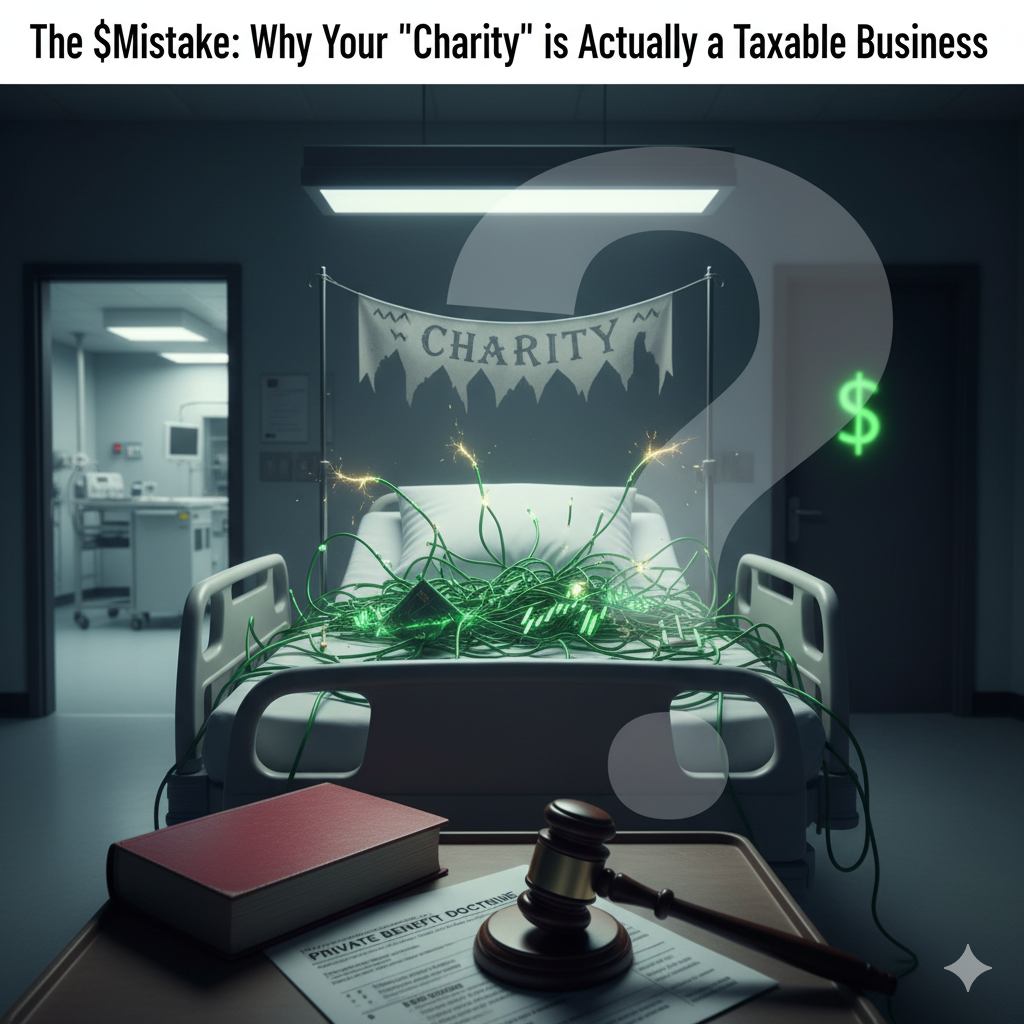
The $Mistake: Why Your “Charity” is Actually a Taxable Business
The Line in the Sand: Nonprofit vs. Business
Every founder with a mission dreams of tax-exempt status. But the path to becoming a recognized public charity 501(c)(3) is fraught with strict legal and financial tests. The true cost of seeking nonprofit status isn’t the filing fee—it’s the risk of having a profitable business structure that fails the charity test entirely.
If you started your organization hoping for tax-exempt status but were denied, or if you realize your current operations would likely lead to a denial—you are running a compromised entity. Your organization is legally exposed, and you need an immediate strategy shift.
The case study of “Organization A“, an entity attempting to navigate the complex world of state-funded specialized care, illustrates this perfectly. They learned the hard way that if the company’s primary function is private benefit or not related to public charity, the IRS will deny its mission—forcing a dramatic and costly pivot.
Establishing a Compliant Nonprofit (The 5 Key Steps)
Before all else, you must define your public charity mission. This mission will guide every legal and financial step that follows.
- State Incorporation (CA SOS): File the Articles of Incorporation (e.g., Form ARTS-PB) with the California Secretary of State (SOS). This legally creates the corporation as a Nonprofit Public Benefit entity.
- Federal EIN: Obtain an Employer Identification Number (EIN) from the IRS. This number is required for all bank accounts, tax filings, and payroll.
- CA Charitable Registration (CA AG): Register with the California Attorney General’s (AG) Registry of Charities and Fundraisers. This is mandatory within 30 days of first receiving charitable assets (donations, grants).
- Federal Tax Exemption (IRS): File IRS Form 1023 (Application for Recognition of Exemption Under Section 501(c)(3)) or Form 1023-EZ. Approval here grants federal tax-exempt status.
- State Tax Exemption (FTB): File Form 3500 or Form 3500A with the California Franchise Tax Board (FTB). This is the California equivalent of the Form 1023, granting exemption from state corporate income tax.
Three Fatal Flaws that Kill a Nonprofit Application
The IRS operates on two core principles: Prohibition of Inurement and the Operational Test. Any public charity must pass both. “Organization A” failed spectacularly on multiple fronts, exposing the following “fatal flaws”:
1. The Indefensible Insider Salary (Prohibited Inurement)
The single quickest way to ensure denial is to pay a founder or insider an excessive salary. Prohibited private inurement occurs when a charity’s net earnings are used to unjustly enrich an insider.
- The “Organization A” Case Study: The Founder was paid excessive compensation for providing services. Since the organization operated without a robust public program, this payment was deemed unjustified and not substantiated by market rates for the service rendered.
- The CPA’s Warning: Compensation must be reasonable—meaning it must be comparable to what a similar professional in a comparable organization would be paid. Without this proof, the IRS classifies the excessive payment as an Excess Benefit Transaction, which leads to denial and potential personal penalties for the founder.
2. The 100% Private Benefit Trap (The Operational Test)
A 501(c)(3) must be operated exclusively for charitable purposes, meaning its public activities must be substantial.
- The “Organization A” Case Study: A high percentage of the organization’s total revenue came from a single private funding stream linked to the care of a Related Adult Beneficiary. This proved the organization’s primary function was to sustain a private, familial employment arrangement, not serve the general public.
- The Rule: Even with volunteer work, if all the organization’s paid resources are concentrated on a private interest, the IRS concludes the charitable mission is merely a “pretext”.
3. Structural Non-Compliance
The nonprofit organization’s failure to establish basic operating procedures sank the application:
- The organization could not provide documentation, detailed Program Policies, or a budget for its stated charitable missions.
- The high-hour compensation claimed lacked essential labor law justification, exposing the directors to personal liability for wage and hour disputes under state law.
The Only Two Viable Paths for Mission-Driven Entities
If your organization has already been denied tax-exempt status or is preparing to apply but is currently compromised because its operations involves related party revenue, specialized services, or high founder compensation, you must choose one of the following compliant paths:
Path A: The Clean Break (Recommended)
This strategy separates the profitable, high-risk operational business from the clean, public charitable function. This is the ultimate lesson learned by “Organization A”.
- Close the Compromised Entity: Dissolve the old nonprofit entity (“Organization A”) immediately. File final corporate tax returns (Form 1120/100) to clear all tax history and obtain tax clearance, avoiding the complex conversion process.
- Form a Taxable Business: Create a new, taxable S-Corporation to handle all fee-for-service work (like contract administration and payroll). This structure provides the necessary corporate liability protection and allows the founder to receive a salary without violating inurement laws.
- Form a Pure Nonprofit: Create a separate, new public charity with a new EIN immediately. This entity must have zero financial history with the founder’s business dealings. Its sole purpose is to raise funds and run the public programs.
Path B: The Correct Nonprofit Structure
If an entity absolutely must be a nonprofit to function (e.g., a hospital or university), all compensation must be carefully managed.
- Third-Party Benchmarking: Compensation for insiders must be determined by a disinterested board based on external, third-party salary surveys of comparable positions.
- Zero Related-Party Revenue: The organization must demonstrate its financial support comes primarily from the public (donations, grants, public program fees) and that services provided to any insider or their family member are incidental to the overall mission.
Final Advice: Never Let Operations Go Uncertified
The key takeaway from this case study is to know your operations. You must be able to certify all your business practices in order to clearly identify and avoid risks.
If you’re concerned that your nonprofit structure is a high risk, do not guess or stall, reach out to us today for a free introductory discovery consultation.
Contact us at Info@mrarrachecpa.com

About the Author
Michael R. Arrache, CPA, EA, DRE
As a Certified Public Accountant (CPA), Enrolled Agent (EA), and licensed Realtor, I am a tax expert who works closely with nonprofits, small business owners and real estate investors. My firm, Arrache CPA, Inc. dba Mr. Smart Tax, provides a range of specialized financial and real estate services, including tax planning, business transactions, and real estate advisory. With over 15 years of experience, my mission is to help clients achieve their financial and business goals by providing strategic advice and tailored solutions. I write these articles to serve as a starting point to guide you through the business or real estate process, and I am committed to providing the strategic guidance you need to help preserve and grow your wealth.


Leave a Reply
Want to join the discussion?Feel free to contribute!